
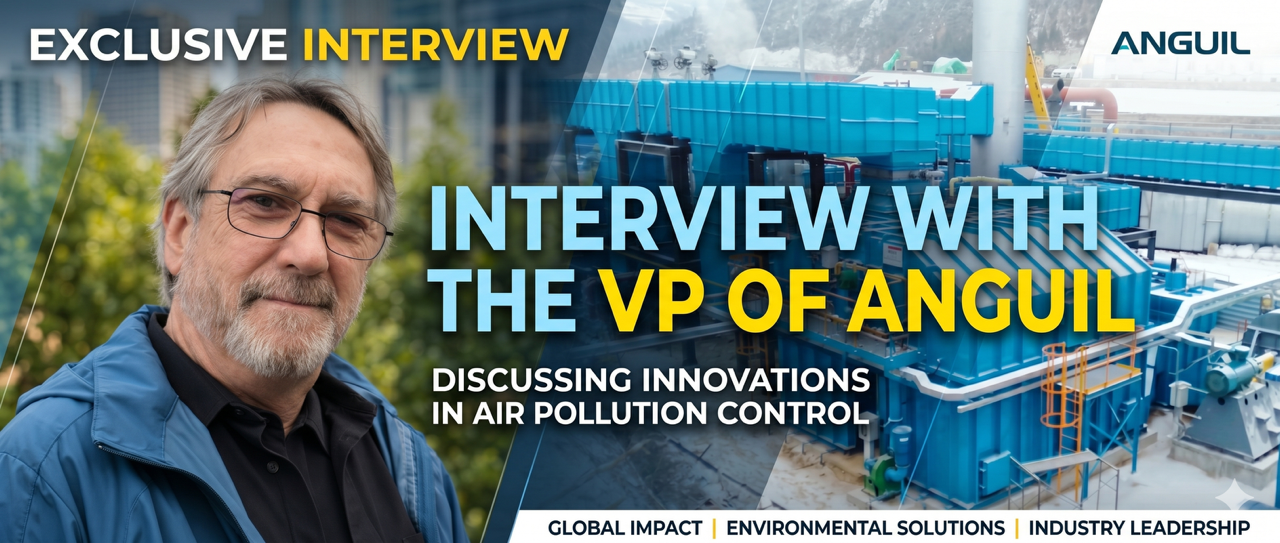
While the world chased billion-dollar climate moonshots, a family-run American industrial company quietly became one of the most important weapons against global warming. Nobody noticed.
By Juneia Mallas – Clean Exit – Methane Brief
The phone call lasts just under an hour. On one end, a journalist in London trying to understand why the cheapest climate solution in existence is going nowhere. On the other, a measured, methodical American engineer who has spent three decades in the unglamorous business of destroying things nobody wants in the air.
The engineer’s name is Rich Grzanka. His employer is Anguil Environmental Systems. And by the time the call ends, one thing is unmistakable: this is not a story about a company chasing the climate emergency. It is a story about a company the climate emergency caught up with.
Built for a Different Problem
Anguil Environmental Systems was founded in 1978 by Gene Anguil. That is not a typo. When the company opened its doors, the first Star Wars film had just been in cinemas for a year, the Environmental Protection Agency was barely a decade old, and climate change was something discussed by atmospheric scientists, not policy-makers. The company’s founding purpose had nothing to do with greenhouse gases. It was built to destroy Volatile Organic Compounds — VOCs — the noxious, invisible byproducts of industrial processes that react with sunlight and air to produce smog, and that in high concentrations cause cancer.
The technology Anguil built its business around was oxidation technology, including the Regenerative Thermal Oxidiser, or RTO. The concept is elegant in its simplicity: force a contaminated gas stream through a ceramic heat exchange chamber, raise the temperature until combustion occurs, and convert the harmful compounds into CO₂ and water vapour. The “regenerative” part is the clever engineering — the heat released by the combustion is captured and recycled back into the system, so the process sustains itself. For four decades, Anguil deployed this technology across the chemical industry, pharmaceutical manufacturing, automotive painting lines, and industrial coatings. The clients were unglamorous. The work was unglamorous. The results, in terms of air quality, were profound.
“The technology has been around since the late seventies,” Grzanka explains, with the measured tone of someone who has said this many times and does not tire of it. “We used it in chemical, pharmaceutical, painting, automotive, industrial applications. Many, many applications .”
The first commercial VAM RTO operation ran in 2007. China followed in 2008. For Anguil, the logic was straightforward: the same principles that had governed decades of industrial oxidation work applied equally to methane. Around 2017, the company began extending its RTO expertise to coal mine emissions and currently has nearly two dozen systems installed worldwide with ten different companies.
The Methane Pivot
Methane is a fuel. It burns. And an RTO, at its core, is a combustion device. The energy released by destroying the methane is enough to sustain the oxidation process itself, which means — crucially — that no supplemental fuel is required, even at methane concentrations as low as 0.2% by volume. The technology can destroy over 98% of the methane passing through it. The engineering challenge had, in a very real sense, already been solved decades earlier.
At this point it is worth pausing on the chemistry, because it is central to understanding why this matters so much. When an RTO burns methane, it converts it into CO₂ and water vapour. To a lay reader, swapping one greenhouse gas for another might not sound like progress. But the exchange rate is extraordinary. Methane is approximately 82 times more potent than CO₂ as a greenhouse gas over a 20-year period. That means every tonne of methane destroyed and converted to CO₂ delivers a climate benefit equivalent to eliminating over 80 tonnes of CO₂ — and does so almost immediately, because methane’s shorter atmospheric lifetime of around 12 years means its warming effect is concentrated in the near term.
Cutting CO₂ today reduces warming over centuries. Cutting methane today reduces warming within years. For a world that has already overshot multiple climate thresholds, the distinction between “centuries” and “years” is not academic. It is the difference between an emergency brake and a long-term maintenance programme.
Anguil’s entry into methane mitigation began in China, through its Asia-Pacific subsidiary Anguil Asia. Underground coal mines in China tend to produce relatively high concentrations of methane in their ventilation air — a product of the geological structure of the coal seams and the way Chinese mines extract air from underground workings. At those concentrations, the energy released by the RTO combustion process is sufficient not just to sustain itself, but to generate surplus heat. That surplus heat can be used to produce steam. And steam can turn a turbine. Which means that in China, Anguil’s systems are not just destroying a dangerous greenhouse gas — they are generating electricity from it.
“Some of the projects in China either generate steam, or generate steam and then turn a small turbine to generate power,” Grzanka says. “That works well in China because the methane concentrations from the mines tend to be higher than, say, Australia.”
The Chinese government, characteristically, did not leave this to the market. Methane abatement in Chinese coal mines has been effectively mandated by the state, folded into the logic of the national energy supply chain. The reasoning, as Grzanka describes it, is almost refreshingly pragmatic: if you are going to burn coal for power — and China will burn coal for power — then destroying the methane at the mining source reduces the climate cost of that decision at the point where it is cheapest to do so. It is not a perfect solution. But it is one that has resulted in more operational RTO installations on coal mines than anywhere else on earth.
The Australian Laboratory
If China represents what methane abatement looks like when the state decides it will happen, Australia represents what it looks like when the market is given a push and then left to find its own way. Australia’s federal “safeguard mechanism” — a carbon tax in all but name — sets baseline limits on greenhouse gas emissions for large industrial facilities. For coal mines emitting more than 100,000 tonnes of CO₂ equivalent per year, the mechanism creates a rising financial penalty for excess methane. The baseline was set at 2018 emission levels, with a target of 50% reduction by 2030 and net zero by 2050. The Australian Carbon Credit Unit, or ACCU, currently trades at around AUD $35 per tonne of CO₂ equivalent, and market analysts expect it to rise into the eighties.
For a coal mine with a long-term supply contract, the maths are starting to work. “Those mines are particularly motivated,” Grzanka says. “They’ve got a long-term customer tied up and they’ve got an increasing cost of production. If they spend the money now and put the RTO technology in, they knock out 98% of the methane. They can actually save money in the long term.” At methane concentrations around 0.8% — higher than typical for Australian mines, but not unusual for gassier operations — analysis suggests a capital payback period as short as two years, once carbon credit revenue is factored in.
The tipping point in Australia may be close. Anguil is currently installing what it calls a demonstration unit in New South Wales — though Grzanka is careful to note the description is more political than technical. “We believe it’s a proven technology, but for the miners in Australia, they want to see one running in their area.” The unit is full-scale and operational. Half of it is funded by the New South Wales government through the coal innovation fund which is administered by the minister of New South Wales Industry and Trade *. Once it proves itself — which Anguil has no doubt it will — Grzanka says several miners are “waiting for this confirmation” before they commit. The end of 2026 or early 2027, he suggests, could be the moment the Australian market tips.
Simultaneously, New South Wales’ own Environmental Protection Agency is developing state-level regulations that would mandate methane destruction at large coal mines — separate from, and additional to, the federal safeguard mechanism. Anguil has been deeply involved in those regulatory discussions, attending workshops and public consultations with miners, regulators, and environmental stakeholders. “We’re installing a unit now,” Grzanka says. “And we’ve got about three or four companies actively looking at doing this.”
The Next Frontier: “Green Coal”
Toward the end of the conversation, Grzanka mentions almost in passing that Anguil is also active in the United States. In the Appalachian coalfields. The details are preliminary — the company is currently analysing a site, gathering technical data, working through the stakeholder processes that any project of this kind requires. He does not elaborate on the specifics. The project is not yet public. But the logic he describes points toward something that may prove more consequential than any regulatory framework: a coal mine choosing to destroy its methane voluntarily, not because it has to, but because it has identified a commercial opportunity that regulation has not yet caught up with.
The opportunity is a simple but powerful idea: “green coal”.
Not a contradiction in terms. A recognition of reality. Coal is not disappearing on any timeline that climate policy has yet managed to enforce — and a new force is actively extending its life. The explosion of AI and data centres has created an electricity demand surge that is straining the US grid in ways few anticipated. Data centre power demand is projected to nearly triple by 2030. The Trump administration has used that surge as justification to issue emergency orders keeping coal plants open past their planned retirement dates. In 2025, operators had planned to retire 12.3 gigawatts of coal capacity. They retired 4.6 — the lowest figure since 2008.
Coal currently supplies around 15% of electricity at US data centres. The mines feeding those plants are venting methane into the atmosphere, unaddressed, while the companies those plants power publish net zero commitments. The data centre boom has simply made the timeline more urgent and the hypocrisy more visible.
The world’s operating underground mines will continue to produce coal for decades — for power generation, for steelmaking, for industrial processes that have no immediate alternative. The question is not whether that coal gets burned. It is whether the methane from the mines where it is dug gets destroyed before it reaches the atmosphere, or whether it is simply vented, invisible and unaccounted for, into the air.
A mine that installs an RTO and destroys 98% of its methane — and holds sensor-verified, continuously logged documentation of that destruction — is producing something meaningfully different from its competitors. Whether that coal feeds a blast furnace or a power station, the mine’s emissions footprint has been reduced at source, before the coal ever leaves the ground. “Green coal” is not a claim that coal is clean. It is a claim that the methane does not need to continue polluting — and that the mines willing to prove it will be in a fundamentally different commercial position when buyers start asking for the evidence.
It is a commercial proposition rather than a compliance one. And it is one that Anguil believes the market is moving toward, whether the industry is ready for it or not.
“A big part of the mine concept,” Grzanka says of the US project, referring to its appearance at a recent industry conference, “is why do we do this? What’s the benefit to us, the miner, for spending millions of dollars voluntarily?” The answer, implicit in the question, is that the benefit is not yet fully priced — but that those who move first will be positioned to capture it when it is. Green coal for green steel, or for lower-emission power generation, is not yet a formal category, a certification standard, or a recognised premium. It is an emerging thesis. But the direction is clear: steelmakers facing Scope 3 reckoning, energy companies under pressure to account for the full lifecycle emissions of the power they sell, and technology giants whose data centres are keeping coal plants alive while their sustainability reports promise net zero — all of them will eventually need to answer the same question. Where did this coal come from, and what happened to the methane? The mines that are building the receipts now, while the concept is still forming, will be the ones with something to sell when the buyers come looking
The Problem with Being Practical
Here is the central irony of Anguil’s position: the company has built, over nearly five decades, an extraordinary depth of expertise in precisely the technology that independent climate scientists say ranks among the top four methane reduction opportunities globally by 2030. And yet it spends a significant portion of its time in conference rooms, at UN workshops, and on calls with journalists, not because it is short of customers, but because the policy and financial architecture required to create those customers barely exists.
The barriers, as Grzanka articulates them with forensic precision, are not technical. The RTOs work. They have worked for years. They have worked in China and Australia and, now, in the United States. They can be built to operate safely at concentrations well below 1% methane. They can be made modular, so that when a mine closes, the equipment can be relocated to the next one. They destroy over 98% of the methane that passes through them. None of this is in question.
The barriers are capital cost, regulatory inertia, and what Grzanka calls, with barely concealed frustration, the “hold off, hold off, hold off” mentality of the mining industry. “They seem to be thinking that if they just hold off, eventually all the need for this methane reduction will evaporate and they won’t have to worry about it.” It is, as he puts it: out of sight, out of mind.
Compounding this is a structural problem that sits above the mining industry entirely. Coal mine methane occupies an awkward institutional no man’s land. The World Bank’s methane programmes address either oil and gas flaring on one side, or agricultural methane on the other. Coal mine methane — the most technically tractable, most cost-effective, most immediately scalable of all methane reduction opportunities — falls between the two. Nobody in the multilateral development bank system formally owns it. Nobody is mandated to fund it. Nobody is incentivised to push it.
The reason for this institutional paralysis is not hard to find, even if it goes largely unspoken. Funding anything associated with coal — even funding the destruction of its most harmful byproduct — carries severe reputational risk for development banks whose public mandates are built around the language of clean energy transition. To finance methane abatement at a coal mine is, in the optics of institutional communications, to finance a coal mine. That the intervention would deliver measurable, immediate, verifiable climate benefits is secondary to the perception that it would lend legitimacy to a sector the same institutions have pledged to phase out. The result is a policy position that prioritises symbolic consistency over actual climate impact: coal mine methane continues to leak into the atmosphere at a rate equivalent to the annual CO₂ output of the entire European Union, while the institutions with the resources to address it look the other way. It is, as one observer of the sector put it, a failure of moral accounting dressed up as a principled stand.
The Unlock Nobody Has Found Yet
Grzanka describes, almost in passing, a financing model that could change everything. A partner company has developed a package in which it offers to design, fabricate, install, and operate an RTO system for a mining company for a fixed annual fee over 10 years — structured like an annuity. The mine pays nothing upfront. It takes on no engineering responsibility. It does not need to operate or maintain the equipment. It simply pays a predictable annual cost and watches its methane emissions — and its carbon tax liability — fall by 98%.
“There are people out there that are beginning to perceive that,” he says carefully. “And we could expand that quite a bit.”
Paired with the emerging promise of engineered carbon credits — verifiable, technology-based offsets that carry none of the reputational risk of forest conservation schemes — the picture becomes even more compelling. A mining company that installs an RTO and destroys 98% of its methane could, in principle, generate credits not just for compliance with local carbon taxes but for international trading under Article 6 of the Paris Agreement. The first completed ITMO transfer — the mechanism that allows carbon credits to cross borders under the Paris framework — was concluded between Switzerland and Thailand in January 2024. It was modest in scale. But it happened. The machinery exists.
Grzanka is sober about timelines. He has watched regulatory frameworks move — or fail to move — for three decades. But he is also, beneath the engineering pragmatism, quietly optimistic. The demonstration unit in New South Wales will prove the technology to Australian miners who have been asking for proof. The regulatory push from the New South Wales EPA will add pressure from above. The annuity financing model can begin to remove the capital cost objection. And the international carbon credit market, however slowly, is building the architecture that makes methane abatement genuinely investable.
“I think we are at a tipping point right now,” he says. “The end of this year, early next year, could be a point where the technology is seen as proven and repeatable. And then we can focus on standardising design, optimising the supply chain, so that we can build it as cost-effectively as possible.”
The View from the Conference Circuit
In the weeks following this conversation, Grzanka flew to Salt Lake City for the Mine Exchange conference, where the emerging concept of voluntary methane abatement in US coal mining had its first serious industry airing. Then to Australia for the Long Wall Conference, where Anguil presented a technical paper on RTO deployment in high-methane coal mines. Then, in April, to Geneva, for the UNECE’s annual Global Methane Forum — the closest thing the international community has to a dedicated annual reckoning with the coal mine methane problem.
Anguil is a privately held, third-generation family business, run by the same family that founded it nearly fifty years ago in the industrial Midwest, doing work that most of the climate finance world has never heard of, competing in a market that does not yet properly exist, for credits that are not yet fully tradeable, under regulations that are still being written. And yet here it is: at the UN. In Geneva. In New South Wales. Making the case, conference by conference, workshop by workshop, that a technology it has been quietly perfecting for decades is the fastest, cheapest, most immediately deployable tool the world has for putting the emergency brake on near-term warming.
The climate crisis, in the popular imagination, will be solved by things that do not yet exist: batteries that last longer, reactors that run cleaner, algorithms that optimise everything. Anguil’s bet is that it will also be solved, in part, by a steel box full of ceramic heat recovery media, pointed at a coal mine ventilation shaft, doing in 2026 what it first learned to do in a chemical plant in 1978.
It is not a glamorous bet. It is, increasingly, looking like the right one.
MORE ABOUT METHANE BRIEF
The Methane Brief grew out of the Clean Exit Campaign — launched June 2025, 500,000+ impressions in six months. Published every two weeks for investors, policymakers, and industry decision-makers who need to act on methane now, not later.
Kaj Embrén — Founder • Juneia Mallas — Lead Researcher • Richard Mattus — Technical Advisor
• #CleanExit • #MethaneAbatement • #CarbonMarkets • #ClimateFinance
