
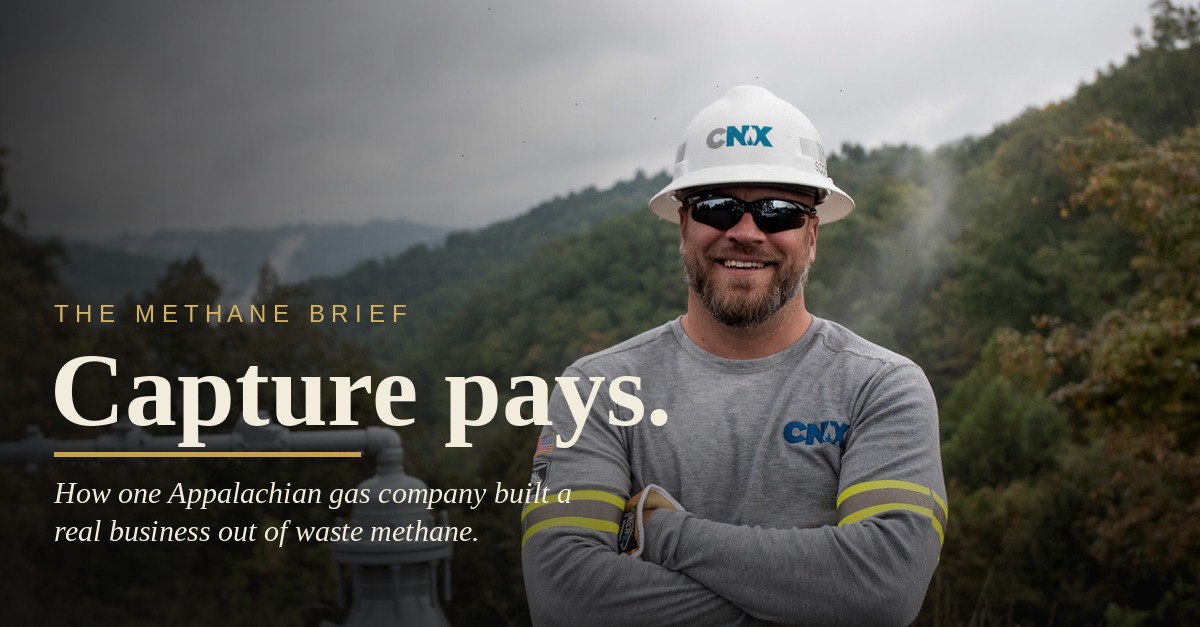
First in a two-part series on how coal mine methane abatement gets financed in the United States. The next instalment will examine the financial instruments needed to scale it.
BY JUNEIA MALLAS · THE METHANE BRIEF
“If we’re serious about climate, we need to get our hands dirty to clean up a mess.”
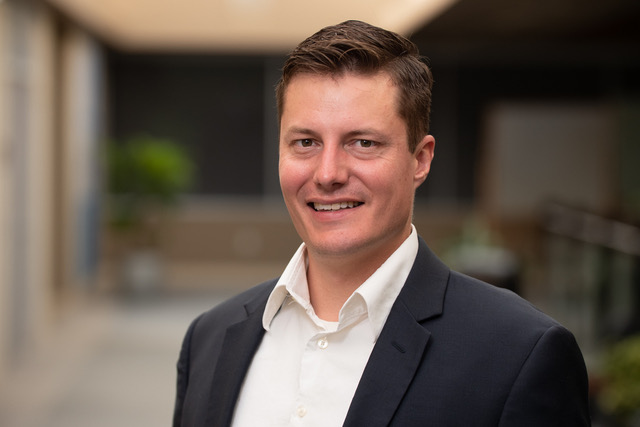
The line comes from Brent Bobsein, Vice President of Sustainable Development at CNX Resources, in a recent conversation with The Methane Brief. It is not the language most sustainability executives use. It is also a reasonably exact description of what the company spends its time doing.
CNX is a publicly listed Appalachian gas company. It captures roughly nine million tonnes of carbon-dioxide-equivalent of waste methane every year — enough, in greenhouse impact, to take about two million cars off the road. Across the US coal industry, by CNX’s own account, roughly seventy percent of mine methane is still vented to the atmosphere; only about thirty percent is captured by any means. Three operators do this work at commercial scale. CNX is one of them.
Three, out of 524 producing coal mines in the country. The question that has shaped CNX’s last two decades is why so few others have followed. The answer, it turns out, is mostly about money.
A gas company that stopped pretending to be a coal company
CNX is not a coal company, even though most of its methane abatement work happens at coal mines. “CNX is not a mine operator,” Bobsein told us. “We have no mineral interest in coal mines. CNX is only a gas company. All of our operations where we’re capturing methane are from third-party mine operators.”
This took deliberate engineering. In 2016, CONSOL Energy — the company CNX was then part of — sold the Buchanan coal mine to the Australian operator Coronado Global Resources. The following year, CONSOL split in two: CNX Resources became the standalone gas company, keeping the Virginia coal-bed methane and gas rights, while a separate coal company kept the CONSOL Energy name.
CNX’s commercial position no longer depends on any individual coal mine continuing to operate. It depends on a simple physical fact: methane has to come out of working coal mines, because at certain concentrations underground it kills miners. The drainage infrastructure was built for safety long before anyone thought about climate. What CNX has done is take that necessity — methane has to be removed, the equipment to remove it already exists — and turn it into a commercial gas business that also keeps a powerful greenhouse pollutant out of the atmosphere.
Most coal mine operators are pure-play coal companies, not gas marketers. They mine coal and sell coal. They have no gas processing capability, no pipeline access, no commercial relationships with the kinds of industrial buyers who pay extra for low-carbon-intensity gas. For most operators, building from “we have methane in our ventilation streams” to “we have a commercial product” means building an entirely new business. That is a lot to ask of a company whose core competence is digging.
What the work actually looks like
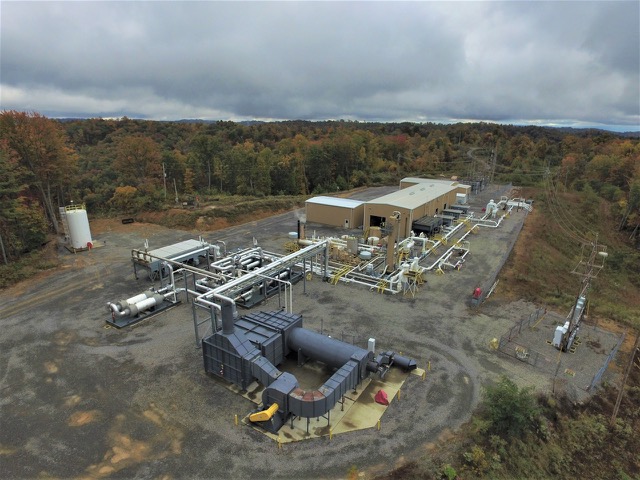
Most of CNX’s methane capture happens away from public view. The technology is undramatic — wells drilled into the rock above mined-out coal seams to collect the methane that releases as the rock relaxes, horizontal wells extending through coal seams to drain methane ahead of mining, pre-mining drainage from seams scheduled for future extraction. The captured gas is processed to pipeline quality and injected into the natural gas distribution network, where it is blended at a 15:85 ratio with shale gas and sold to industrial buyers. Increasingly, those buyers are data centres, which need low-carbon-intensity gas supply to satisfy their own emissions disclosure obligations as their electricity demand surges.
The numbers are large. The nine million tonnes of CO2-equivalent CNX reported capturing in 2024 is roughly twenty times the company’s own direct emissions from gas production. It is methane that, in the absence of capture infrastructure, would almost certainly have been vented to the atmosphere. Asked to put the scale in perspective, Bobsein offered a comparison: capturing nine million tonnes of CO2-equivalent has roughly the same annual greenhouse impact as a new forest the size of Portugal.
Most of the methane CNX captures ends up combusted — either by industrial buyers who purchase the gas through the pipeline, or on site at smaller facilities where it generates power directly. Combustion converts methane into CO2. CO2 has a much lower warming impact than methane, which is the whole point: the climate value of methane abatement comes from the difference between the two. The carbon atoms are still in the atmosphere, just in a far less potent form. A smaller share of CNX’s captured methane goes somewhere different. Through a partnership with a company called Newlight Technologies, some of it is converted into bioplastics. The volumes are modest, but the principle is interesting: the carbon stays locked in the manufactured material rather than entering the atmosphere at all. It is one of the more inventive things happening in the engineered methane abatement space, and it points toward what the next generation of this work might look like.
Why three operators, and not three hundred
CNX’s commercial architecture is what makes the work financially viable. It is also what makes it hard to copy. The company has stacked five distinct revenue streams against a single physical operation.
Federal tax credits flow through two Inflation Reduction Act provisions — Section 45V for clean hydrogen production and Section 45Z for clean fuel — because CNX’s gas has a carbon intensity low enough to qualify under Argonne National Laboratory’s lifecycle model. Six US states (Pennsylvania, Ohio, Indiana, Colorado, Illinois, and Utah) recognise CNX’s Remediated Mine Gas under their Renewable Portfolio Standards, generating state-level credits. State capital grants have helped underwrite project finance — Pennsylvania’s RISE PA programme contributed $32 million to one CNX project alone. Premium offtake to industrial buyers, particularly data centres, is now potentially the largest single revenue source over the medium term. And voluntary carbon market environmental attributes flow through CNX’s exclusive arrangement with Anew Climate.
Most active US coal mines are operated by pure-play coal companies in states with no RPS recognition for mine methane, far from the kinds of industrial offtake demand that produces premium pricing, without the corporate infrastructure to navigate federal tax credit qualification
or to run multi-year contractual relationships with environmental attribute marketers. The gap between three operators and the rest of the industry is not principally about technology. It is about money — about who can stack which revenue streams against which physical operation, and about which operators are positioned to do so.
This is the question the second article in this series will examine in detail: what new financial instruments would be needed to close the gap. For the rest of this piece, the question is what CNX’s own work demonstrates — about the company, about the communities where it operates, and about a single mine in southwestern Virginia where the financing complexity that defines this whole space comes into sharp relief.
A mine where two financing models share a fence line
Buchanan #1 sits in Buchanan County, Virginia. CONSOL Energy sold the mine to Coronado Global Resources in 2016, the year before CONSOL split and CNX Resources became the standalone gas company; Coronado, an Australian publicly listed company, operates it now. CNX retained the gas rights through its subsidiary Pocahontas Gas LLC, which holds the underlying pooling authority for the methane at the production unit under Virginia Gas and Oil Board jurisdiction. The drainage gas captured at Buchanan flows into CNX’s integrated commercial architecture along with the company’s other drainage gas operations.
But two of the mine’s vent shafts — labelled VS16 and VS18 — also have regenerative thermal oxidation units installed on them. These oxidisers handle a different kind of methane stream: ventilation air methane, which comes out at concentrations too low to inject into a pipeline and has to be destroyed in place. The units were supplied by a Canadian specialist called Biothermica, which has been in this technology for over two decades. The registered carbon offset project proponent for the credits the oxidisers generate is a different company again: NextEra Energy Marketing, LLC. And those credits flow into a carbon offtake arrangement with Mountain Valley Pipeline, the recently completed interstate gas pipeline running between West Virginia and Virginia.
So at one mine, two methane streams are being abated under two completely different commercial structures. The drainage gas — high- concentration, pipeline-quality — sits inside CNX’s integrated commercial model. The ventilation air methane — too dilute to sell, but climate- significant when destroyed — sits inside a four-party architecture. Coronado operates the mine. CNX holds the gas rights. Biothermica supplied the technology. NextEra holds the carbon project.
CNX, asked about the specific commercial terms governing the VAM credits at Buchanan, declined to comment on the record. The project structure is fully public — the project registration with the American Carbon Registry, the certification under California’s compliance market, the Virginia pooling order — but the financial arrangements between the parties are confidential. That is commercially rational and unremarkable. It is also a useful reminder that the carbon credit market, even in its most institutionally credible corners, is structured around private commercial agreements rather than public ones.
The broader point is what Buchanan reveals. A single mine, two methane streams, two financing structures, four companies. Methane abatement at commercial scale rarely fits neatly inside one operator’s commercial architecture. The next generation of finance for this work will have to handle that complexity — and the second article in this series will return to Buchanan as a worked example of why.
What CNX does that doesn't show up in the methane balance sheet
The other thing that makes CNX distinctive is harder to put in a spreadsheet. The company has thought, more carefully than most operators in this sector, about its relationship to the places where it actually does the work.
CNX calls its community investment strategy TIL — Tangible, Impactful, Local. The framing matters because it shapes what gets funded and how. Most corporate philanthropy is structured around institutional accountability, which produces predictability and slowness. TIL is structured around speed and local responsiveness. It is a smaller idea than it sounds, and a more deliberate one than most company foundations attempt.
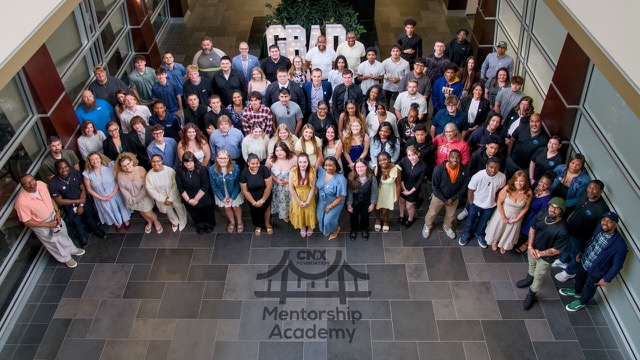
The most developed expression of TIL is the CNX Mentorship Academy. Launched in August 2021, the Academy works with juniors and seniors across high schools in southwestern Pennsylvania — including some of the most economically distressed parts of Pittsburgh — pairing students with industry mentors and exposing them to a range of career paths beyond the four-year university track. More than 400 students have come through the programme since its launch four years ago. The 2024-2025 cohort had 73 graduating seniors. More than thirty percent went straight into full- time employment in the trades. Fifty-one percent went on to further education. Enrolment in the current cohort grew by sixty percent.
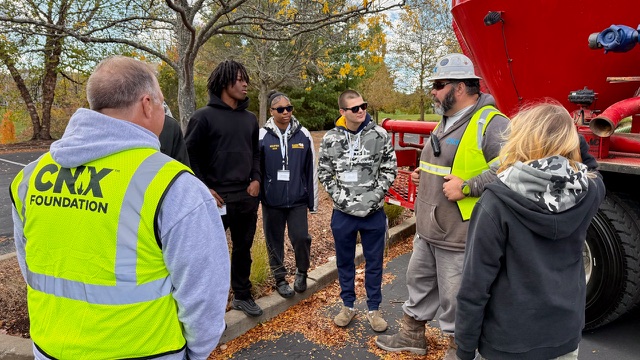
The Academy doesn’t end at graduation. CNX built two complementary programmes around it: the CNX Energy SSE Internship, which places graduating students into paid internships across the energy sector, and a workforce-development partnership with UPMC called M.O.V.E.S., which personnel. The Academy works with high schools across southwestern Pennsylvania. extends the same pipeline approach into healthcare. The scaffolding matters. Many corporate mentorship programmes are essentially supply — they expose students to careers without doing the work to make sure jobs are actually available. CNX’s commitment is to support graduates into employment in industries of their choosing, which means the programme functions as labour market infrastructure as much as educational intervention.
“What we found is that having these types of mentorship and career-readiness programmes in our communities helps reduce things like school violence and absenteeism. So tangible benefits really play.”
Another community component is MicroTIL — the initiative the CNX Foundation launched in 2025 as a deliberate move away from the standard corporate foundation model. MicroTIL replaced the conventional application-based grant cycle altogether. Instead, the Foundation
provides targeted assistance to individual families who fall outside organisational eligibility rules or whose needs are too urgent for traditional grant timelines to accommodate. Since launch, MicroTIL has resolved 87 individual cases across five Appalachian counties. The number is modest by foundation standards but the principle is unusual. Most corporate philanthropy is built around institutional intermediaries. CNX moved deliberately in the opposite direction — closer to the families themselves, with the speed and discretion that comes from cutting out the application process.
The CNX Foundation gave $4 million across 134 initiatives in 2025. CNX employees logged more than 2,176 volunteer hours. Ninety-nine percent of CNX employees live in the company’s operating region — the same Appalachian counties where the methane capture happens, the same towns where the Mentorship Academy graduates either stay or come back to. The company’s local small-business spend reached 64 percent of total small-business expenditure in the same year. Median employee compensation reached $174,876, high for a region where median household incomes in many counties remain well below half that figure.
When asked to summarise CNX’s relationship to its host region, Bobsein put it simply. CNX is, he said, “a company that works for the people who live where we work.”
There is an editorial point here that matters beyond CNX’s individual case. Most coverage of operators in this space treats social licence as either marketing or as separable from the technical climate work. Both readings are wrong. The ability to operate sustainably in a community over decades is part of what makes long-horizon climate infrastructure possible at all. The Mentorship Academy is not why CNX captures methane. But it is part of why CNX can keep capturing methane through political and commercial cycles that would have ended a less embedded company’s projects years ago. For operators thinking about methane abatement work in other parts of the country, this matters.
What CNX's case actually demonstrates
CNX has built something that works. Five revenue streams stacked against one physical operation. A measurement architecture more comprehensive than anything else in the engineered methane abatement category. A relationship with its host communities that has survived twenty years of political and commercial cycles. Methane that would otherwise have leaked into the atmosphere, captured at industrial scale, year after year.
The harder question is what the rest of the industry does with this. Bobsein himself was direct about it. The CNX model, he told us, depends on conditions that most operators do not have — gas infrastructure already in place, state policy that recognises Remediated Mine Gas, industrial buyers within pipeline range who want low-carbon-intensity supply. Not every operator can do what CNX has done. Some, he said, will need different structures. Some will need partners who can take on the parts they cannot do themselves.
He spent the last part of our conversation describing what those structures might look like. Financial risk hedging that could lock in carbon credit prices or insure against change-in-law risk in federal tax programmes. Insurance companies entering a market they currently treat as too small and too specialised. “That’s where insurance companies, I think, could step up,” he said, “and this could be a part of their sustainability mission as well.” He mentioned that at a recent industry conference in Geneva, an insurance representative had spoken up directly about the methane category — about the portfolio risk of staying out, and about wanting to engage.
The conversation moved through other possibilities too. The reinsurance sector has spent two decades building instruments that let institutional capital take exposure to risks the market once treated as untouchable, and there are reasons to think methane credits could become a similar category if the right architecture were built around them. An old analogy from financial history came up as we tried to capture the gap: the junk bond market in the late 1970s, where the underlying cash flows were real and the assets were undervalued but the instruments that would let large pools of capital actually hold them did not yet exist. Once that architecture got built, the market followed. Methane abatement credits in 2026 sit in something like that position.
Whether the architecture gets built is not CNX’s question to answer alone. The company has done what one operator can do in one corner of one industry in one country. Three out of 524. The methane CNX captured is now CO2 in the atmosphere, or carbon locked in a Newlight bioplastic, or gas in a pipeline heading toward a Pittsburgh-area data centre. Across the rest of the industry, most of the methane is still going straight up — roughly seventy percent of it, unabated.
The interesting question — the one that hangs over the rest of this series — is who builds the financial instruments that would let the next generation of operators do what CNX has spent two decades doing. Bobsein has his view. A small number of other people working at the intersection of climate finance and engineered abatement have theirs. The Brief will be reporting on what they think, and what they are doing, in the next instalment.
For now, CNX continues. The capture wells run. The pipelines carry the blended gas. The Mentorship Academy enrols a new cohort. Bobsein goes back to a job that, fourteen years in, still does not have a generally accepted name in the climate world — somewhere between sustainability strategy, gas commercial development, and the slow, unglamorous work of making methane abatement pay for itself.
“Get our hands dirty to clean up a mess,” he had said. That is the most honest summary of what one company has been doing while most of the climate world has been looking elsewhere.
THE DETAIL — FOUR NOTES FOR THE TECHNICALLY MINDED
1 How CNX measures methane
CNX runs an unusually comprehensive verification stack for the carbon market. Seven distinct measurement and assurance layers operate across its methane abatement work.
Safety-grade continuous monitoring. Methane flow and concentration at the capture point are monitored continuously through instrumentation that CNX maintains for federal mine safety compliance — meaning the underlying measurement data is held to a regulatory standard most voluntary carbon market categories do not have to meet.
Pipeline injection reconciliation. Captured volumes are reconciled against the records of gas physically injected into the pipeline network. Offtaker reconciliation. Volumes are reconciled a second time against the receipts of industrial buyers at the point of sale.
Third-party assurance. Keramida Inc., a global sustainability assurance firm, provides limited assurance on CNX’s Scope 1 and Scope 2 emissions, and on the air, water, and waste data, for 2023, 2024, and 2025.
Production methane intensity certification. Project Canary’s TrustWell standard certifies CNX’s production methane intensity at Platinum level, applying EPA Subpart W methodology.
Independent state monitoring. In May 2025, the Pennsylvania Department of Environmental Protection began what CNX describes as the most intensive independent study of unconventional gas wells in the United States, with continuous access to a Washington County well pad for monitoring of air emissions before, during, and after well development. This is a state environmental regulator running independent monitoring on a private operator’s infrastructure — a verification layer that operates entirely outside the voluntary carbon market.
Environmental attribute marketing. Anew Climate, under an exclusive arrangement renewed in July 2025, handles the registration and sale of CNX’s voluntary market environmental attributes.
The nine million tonnes headline figure for captured waste methane sits in a separate operational accounting framework from the audited ESG scorecard data. The underlying measurement architecture is among the strongest in the engineered methane abatement category. What the sector as a whole has not yet built is a single integrated standard that synthesises across the measurement, verification, attribution, and offtake layers. CNX, with the most developed architecture in the US market, is well placed to contribute to that work as it develops.
2 GWP100 versus GWP20
Methane is much more potent than carbon dioxide as a warming agent. How much more potent depends on the time horizon used to measure it.
Over a hundred years, the Intergovernmental Panel on Climate Change’s Sixth Assessment puts methane’s global warming potential at about 30 times CO2. Over twenty years — closer to the actual atmospheric lifetime of a methane molecule, which decays in roughly 12 years — the IPCC figure rises to 82 times CO2.
Most of the carbon market still measures methane on the hundred-year basis. The Brief’s editorial standard is the twenty-year basis, because methane abatement is precisely the kind of climate intervention that matters most in the near-term warming window we are currently living through.
CNX, in its 2024 and 2025 reporting, uses the IPCC Fifth Assessment hundred-year basis (CH4 = 28× CO2). The company updated from the older Fourth Assessment basis (CH4 = 25× CO2) in 2024.
The choice of time horizon changes the apparent cost-effectiveness of methane abatement by a factor of roughly three. At GWP100, mine methane abatement comes in at around $20 per tonne of CO2-equivalent. At GWP20, the same physical activity costs around $7 per tonne. The methane is the same. The atmosphere responds the same way. The accounting choice changes the number on the page — and the number on the page changes which projects get financed.
3 The Buchanan architecture
At a single coal mine in southwestern Virginia, four companies operate under four distinct commercial roles in the methane abatement work happening on site.
Coronado Global Resources owns and operates the Buchanan #1 coal mine. The Australian publicly listed company bought it from CONSOL Energy in 2016, the year before CONSOL separated its gas business into what is now CNX Resources.
CNX, through its subsidiary Pocahontas Gas LLC, holds the underlying gas and methane rights at the mine. Pocahontas Gas is the applicant on the Virginia Gas and Oil Board pooling order for the relevant production unit.
Biothermica, a Canadian cleantech company, supplied the Vamox regenerative thermal oxidation units installed on two of the mine’s ventilation shafts (vent shafts 16 and 18). The units came online in 2022 and abate ventilation air methane — a much more dilute methane stream than the drainage gas CNX captures elsewhere, at concentrations too low for pipeline injection.
NextEra Energy Marketing, LLC is the registered carbon offset project proponent for both vent shaft projects. The credits are CARB-eligible California Carbon Offsets, registered through the American Carbon Registry, and the credit stream is structured under an offtake arrangement with Mountain Valley Pipeline.
The commercial terms governing the relationships between these four parties are confidential. The basic project structure is fully public through the ACR registration, the CARB certification, and the Virginia Gas and Oil Board pooling order.
Buchanan is a useful example of how methane abatement at a single physical operation can involve multiple distinct financing models simultaneously — in this case, CNX’s integrated commercial model on the drainage gas side coexisting with a third-party developer arrangement on the ventilation air methane side.
4 The Subpart W story: why 2025 looks worse than 2024
CNX’s reported Scope 1 methane emissions jumped from 3,303 tonnes in 2024 to 17,717 tonnes in 2025 — a five-fold increase in a single year. Anyone reading the company’s ESG Performance Scorecard at face value might conclude that operations deteriorated dramatically.
The actual explanation is more interesting and less alarming. Under Section 136(h) of the Inflation Reduction Act, the EPA’s Subpart W reporting framework — the federal standard for how oil and gas companies measure and report methane emissions — was substantially revised, with new rules taking effect for 2025 reporting. The revised methodology counts methane that the old methodology missed or under-counted.
CNX’s underlying physical operations did not get worse in 2025. The federal measurement framework got more rigorous.
This is itself part of a broader story about how methane emissions get counted, and why the numbers a casual reader sees often have less to do with operational performance than with measurement methodology. The same physical activity at CNX produces “3,303 tonnes” under one framework and “17,717 tonnes” under another. The shift between the two figures reflects nothing about the physical reality of the operations and everything about how the federal reporting rules chose to count.
The implication matters. When the financial instruments that scale methane abatement are eventually built — for credit issuance, for tax credit qualification, for institutional investment frameworks — the choice of measurement methodology is itself a critical design question. Different methodology choices can change the apparent climate value of the same physical activity by multiples. The Brief’s broader argument that the carbon market is mispricing engineered methane abatement is partly a story about how methodology has been working against the category, not for it.
