

By Kaj Embren, Senior Advisor | Sustainability & Climate Strategies | Award-Winning Social Media Influencer | Podcaster | Speaker
London, England
Published ahead of London Climate Action Week, 20–28 June 2026
I have lost count of the climate events I have attended over the years. The COPs with their sprawling negotiating halls and last-minute text battles. The democracy festivals in Visby and Arendal where cabinet ministers debate alongside students on sun-drenched harbour fronts. The local Climate Weeks in cities across Europe and beyond, where ordinary people discover that the transition is not something that happens to them — it is something they are already building.
After all of it, I want to draw some conclusions — and point to where the real work is happening.
What COP is — and what it isn’t
Let me be honest about COP. I have watched those final plenary nights enough times to understand both the necessity and the limits of the format. COP matters enormously. The Paris Agreement came from it. The Loss and Damage Fund came from it. The historic agreement at COP28 in Dubai, which for the first time named fossil fuels as the problem, came from it.
But COP30 in Belém last year illustrated the limits just as vividly. A coalition of around 80 nations pushed for a formal “roadmap” away from fossil fuels in the final outcome text. It failed. The words “fossil fuels” did not appear. Countries including China, Russia and the US were simply not in the room for those conversations. That failure did not end the conversation — it redirected it.
Within months, Colombia and the Netherlands co-hosted the First International Conference on the Just Transition Away from Fossil Fuels in Santa Marta, Colombia, from 24–29 April 2026 — a direct, deliberate response to what had been left unsaid in Belém. It included a science pre-conference with around 400 academics, a dedicated day for subnational governments and civil society, a Peoples’ Assembly, and a high-level ministerial segment. Nearly 60 countries attended. The findings are now being delivered to the COP30 presidency, which is preparing a global fossil fuel roadmap for COP31 in Antalya, Turkey, this November. The work is happening in the gaps — not just at the summits.
The grassroots engine that keeps running
While diplomats negotiate, something far larger and arguably more durable has been quietly growing for over a decade: a global network of Climate Weeks.
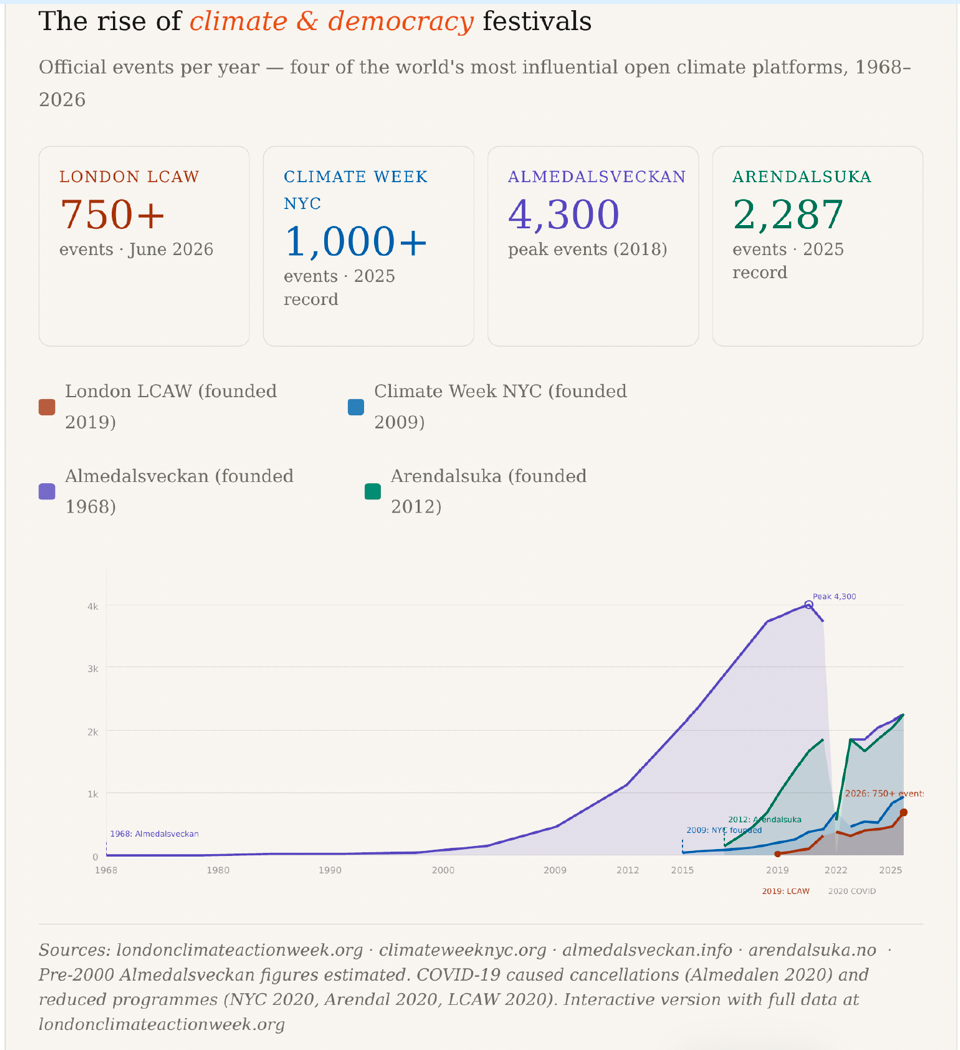
London Climate Action Week opens on 20 June — in just days. Now in its eighth year, it is Europe’s largest independent climate event: nine days, more than 750 events across the whole city. From community gatherings in every London borough to ministerial roundtables, the Climate Innovation Forum at the historic Guildhall, school summits, and conversations at the London Stock Exchange. Free, open to all.
Full programme for London Climate Action Week 2026: londonclimateactionweek.org
Climate Week NYC, now in its 17th year, this past September brought together over 100,000 people across more than 1,000 events — the most significant international climate gathering outside of COP. Started in 2009 with a handful of events alongside the UN General Assembly, it now spans everything from closed-door ministerial roundtables to public art installations in Times Square.
And beyond these flagships, the network keeps spreading: Shanghai, Bangkok, Sydney, Rio de Janeiro, and more than 20 other cities have confirmed Climate Weeks for 2026. The UNFCCC itself launched its own biannual Climate Weeks platform in 2025. The Brazilian COP30 presidency has identified Climate Action Weeks as a key platform for real-world delivery — the action agenda coming alive in cities and communities around the world.
A nursery for democracy — the Nordic model
Some of the most important climate conversations I have witnessed happen in spaces that never call themselves climate events. Nowhere is this truer than in Visby.
Almedalsveckan — Sweden’s annual political festival — is one of the most remarkable democratic institutions I have ever encountered. I have been engaged there more than ten times since 1970, and it never loses its power to surprise.
The concept is beautifully simple: all eight of Sweden’s parliamentary political parties come together on the island of Visby for a five-day festival in the last week of June, organised through their local representatives on Gotland, hosted by the Municipality. Each party has half a day in Almedalen — the central park — to promote new policy proposals. Since 1996, organisations and businesses have been welcomed alongside the parties. Anyone can apply to organise an official event. The result in 2025 was 2,421 official events over five days. Unofficial fringe gatherings multiply that number considerably.
Visby itself — a UNESCO World Heritage medieval city of around 25,000 inhabitants — sits 180 kilometres and a boat trip from Stockholm. During Almedalsveckan, an estimated 35,000 unique visitors arrive by ferry and plane. Politicians, business leaders, academics, civil society representatives, journalists, and ordinary citizens mix freely. Many come as part of their summer holiday. There is no hierarchy of access. The whole island becomes a forum.
I have always thought of Almedalsveckan as a nursery for democracy — a place where ideas are brought in fragile form, tended carefully, and sent out into the world with roots. In 2025, nearly 80 sessions addressed sustainability and the built environment. Sweden’s hydrogen strategy, fossil-free aviation, circular construction, climate targets — all debated openly in a park.
Arendalsuka, Norway’s “democracy festival” held every August in the coastal town of Arendal, was directly inspired by Almedalen. Launched in 2012, it has grown into Norway’s largest political gathering: five days, 2,287 events, 160 venues, nearly 190,000 visits to a city of 45,000 people. Cabinet ministers walk unescorted between debates. Corporate representatives share stages with climate activists. A youth programme brings 6,000 young people aged 4 to 19 into the conversation each year. Like Almedalsveckan, it is completely free and open to all.
Denmark’s Folkemødet and Finland’s SuomiAreena complete the Nordic quartet. Together these four democracy festivals represent a model the rest of the world should study: genuinely open, genuinely cross-sector, and genuinely effective at turning climate policy into public conversation. When climate is embedded in a broader festival of democracy, it stops being the environmentalists’ issue and becomes everyone’s issue.
My conclusions — what the evidence now tells us
1. The action happens between the COPs.
Santa Marta. Climate Week NYC. London Climate Action Week. Almedalsveckan. These are not warm-up acts for the next negotiating round. They are where coalitions form, where science reaches policymakers informally, where cities and regions move faster than national governments. The days between summits matter as much as the summits themselves.
2. Local is not small — it is different, and often more powerful.
A Climate Week in a London borough is not a scaled-down version of a global event. When a school in Brent premieres a film about student climate projects, or a community runs a Climate Fresk workshop, they create a cultural shift no treaty text can mandate. The number of events globally has grown from dozens in 2009 to over a thousand in a single week in New York alone. That is infrastructure.
3. Democracy and climate are inseparable.
Almedalsveckan understood this in 1968. Arendalsuka understood it in 2012. You cannot sustain ambitious climate action without democratic legitimacy. When people feel included — not just informed — they act differently. The open-access model is a direct counter to the democratic deficit that makes climate fatigue so dangerous.
4. The fossil fuel conversation cannot be avoided forever.
Santa Marta proved that when formal processes fail, determined coalitions find another way. Nearly 60 countries, 400 scientists, and a global civil society came together in Colombia to say what COP30 could not write down. That conversation is heading to COP31 in Antalya. It will not go away.
5. The movement is now self-sustaining.
In 2009, climate action was niche. Today more than 20 cities have active Climate Weeks. Democracy festivals across the Nordic region embed climate in their core programming. Schools hold their own summits. The question is no longer whether the movement exists — it is whether those of us here from the beginning are doing enough to amplify it.
What comes next
COP31 in Antalya this November will receive the fossil fuel roadmap that Santa Marta helped build. London Climate Action Week opens on 20 June — this week. Climate Week NYC returns in September. Almedalsveckan is just weeks away in Visby. Arendalsuka follows in August.
The calendar is full. The movement is real. The path already exists — distributed across a thousand local events, a hundred harbour-front debates, and decades of accumulated pressure from people who refused to give up.
My conclusion, after all of it, is this: show up to the local events as seriously as you show up to the global ones. The climate crisis will not be solved in a single conference room. It will be solved by the accumulated weight of people who kept the conversation alive in every city, every summer, every year — in a park in Visby, on a harbour in Arendal, in a school hall in Brent, on a June morning in London — until the world finally caught up.
For decades the nursery has been quietly growing something extraordinary — ideas raised with care and sent out with roots. It is time to plant them everywhere.
London Climate Action Week 2026 · 20–28 June · 750+ events · Free & open to all (Some professional forums and flagship events charge for attendance )
Climate Week NYC · 20–27 September 2026 · Almedalsveckan · late June · Visby, Gotland, Sweden · Arendalsuka · August · Arendal, Norway · COP31 · November 2026 · Antalya, Turkey
Want to go deeper?
Many of the conversations that shaped this roadmap started in exactly the kind of places this article describes — democracy festivals, climate weeks, and the corridors between COPs. On my podcast, Transformers — The Sustainability Changemakers, I have conversations with the business leaders, policymakers, and activists who are actually doing the work of transformation. From circular economy pioneers to green finance architects to urban climate leaders — these are the people planting ideas in the nursery and sending them out into the world with roots. Listen on Spotify, You Tube or Apple Podcasts.
